Tower Rush - Bonus and demo of the official game
Tower Rush ▷ Official Tower Game | Bonus & Demo
It worked. And the reason can be summed up in one word: the tower. Not the multiplier, not the RTP, not the bonuses. The tower. This visual construction that grows before your eyes, block by block, and each floor represents a decision made with your hands and nerves. This is what makes Tower Rush different from anything that existed before.
Our rating: 4.1 / 5 ★★★★☆
The crash game that has found a way to make the player an active participant in their game, not just a simple spectator. The tower building mechanic creates an engagement that passive formats cannot replicate. Three well-thought-out bonuses complete the whole. The free demo remains the best way to understand why this game generates so much positive feedback.
Why the tower mechanic changes everything
In a classic crash game, you place your bet, watch a number rise, and press a button when you want to cash out. It’s a single decision: when to exit. Nothing else requires your attention.
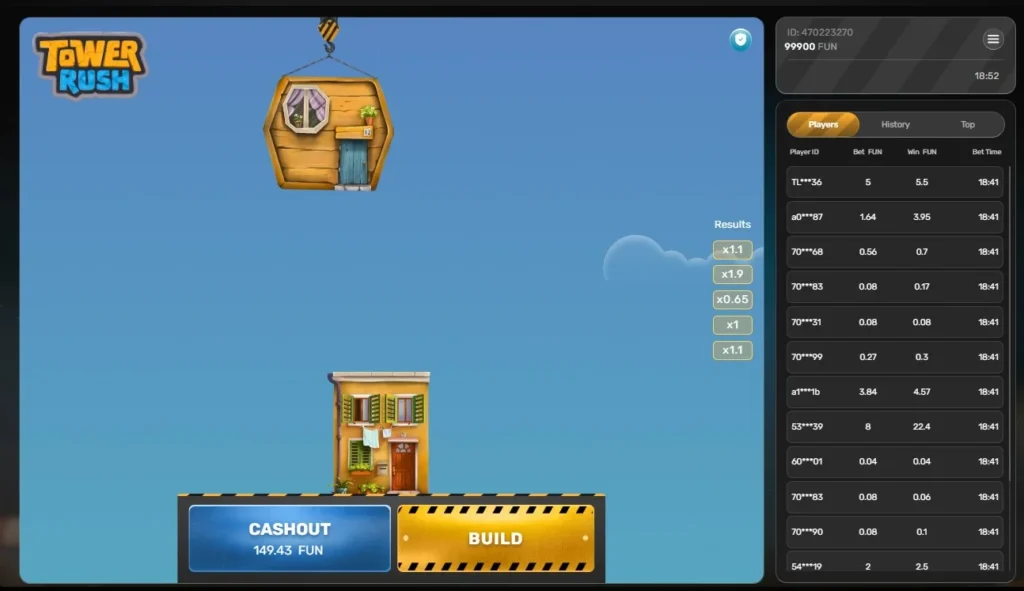
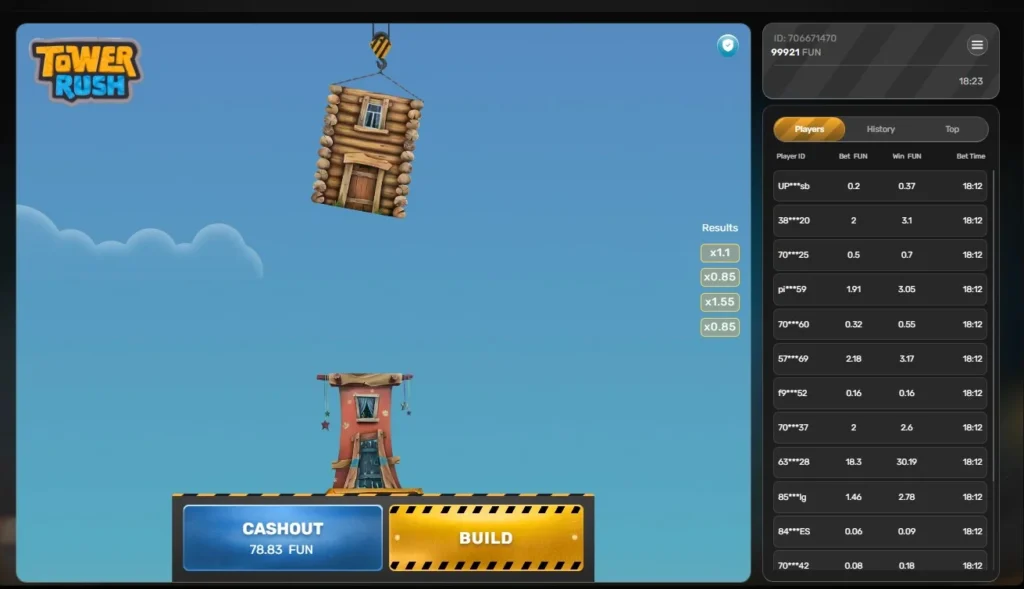
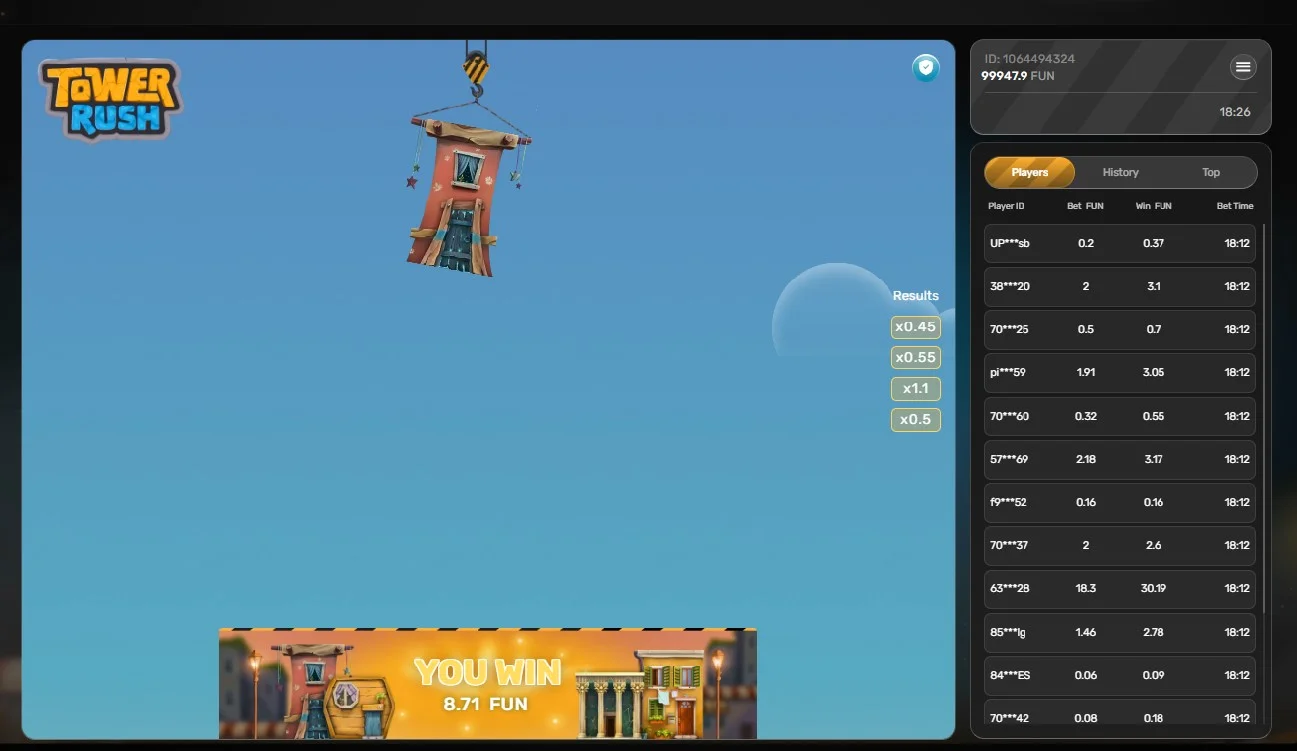
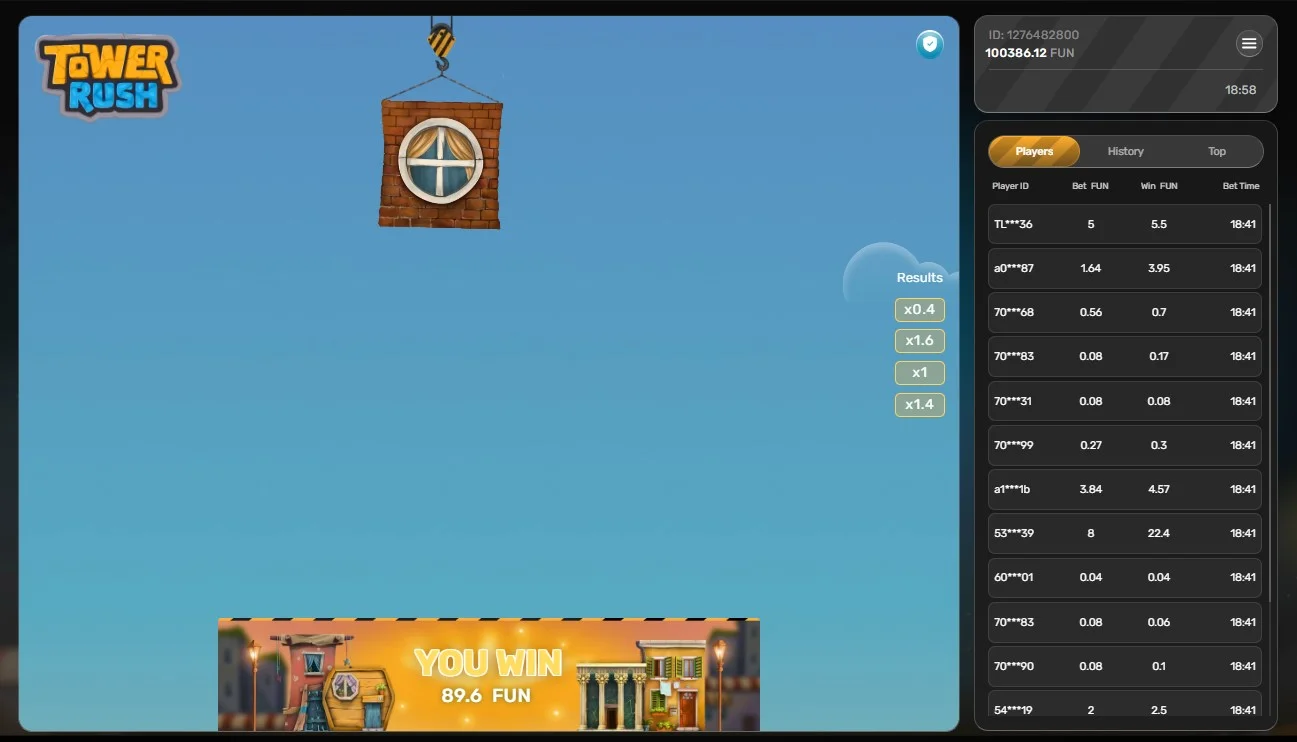
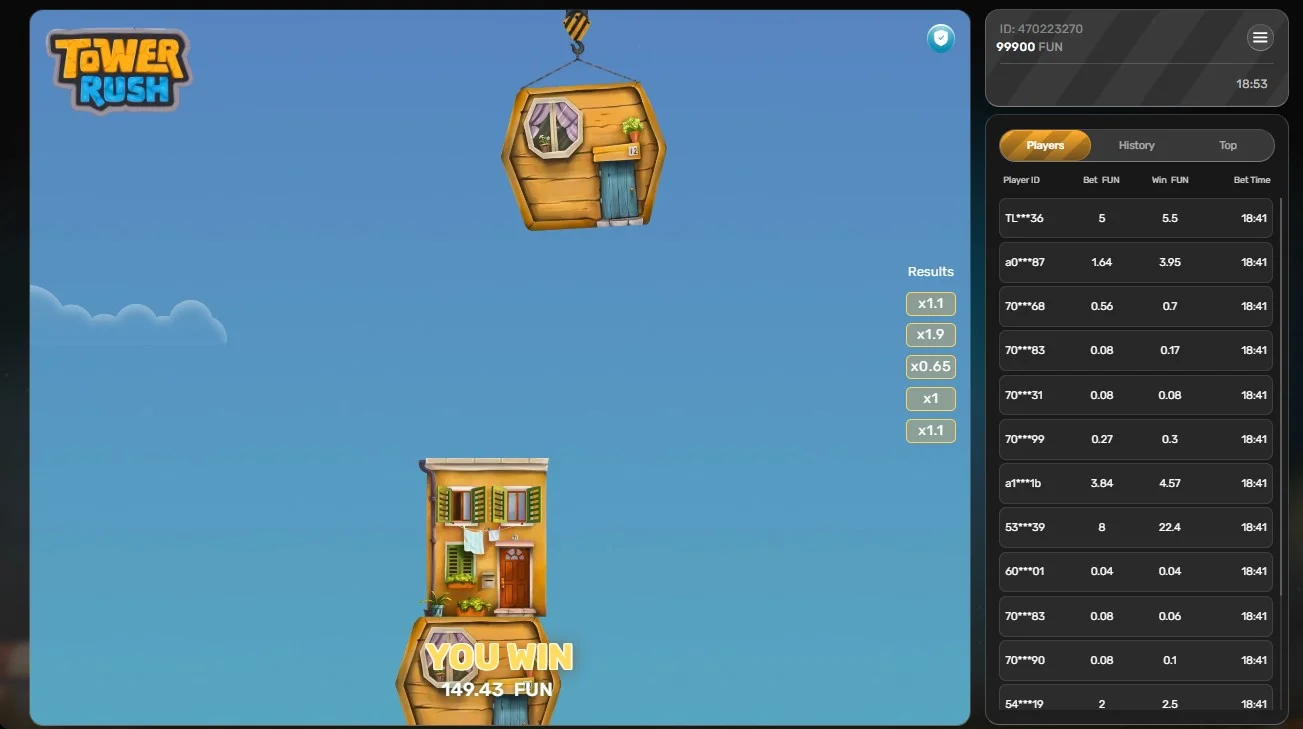
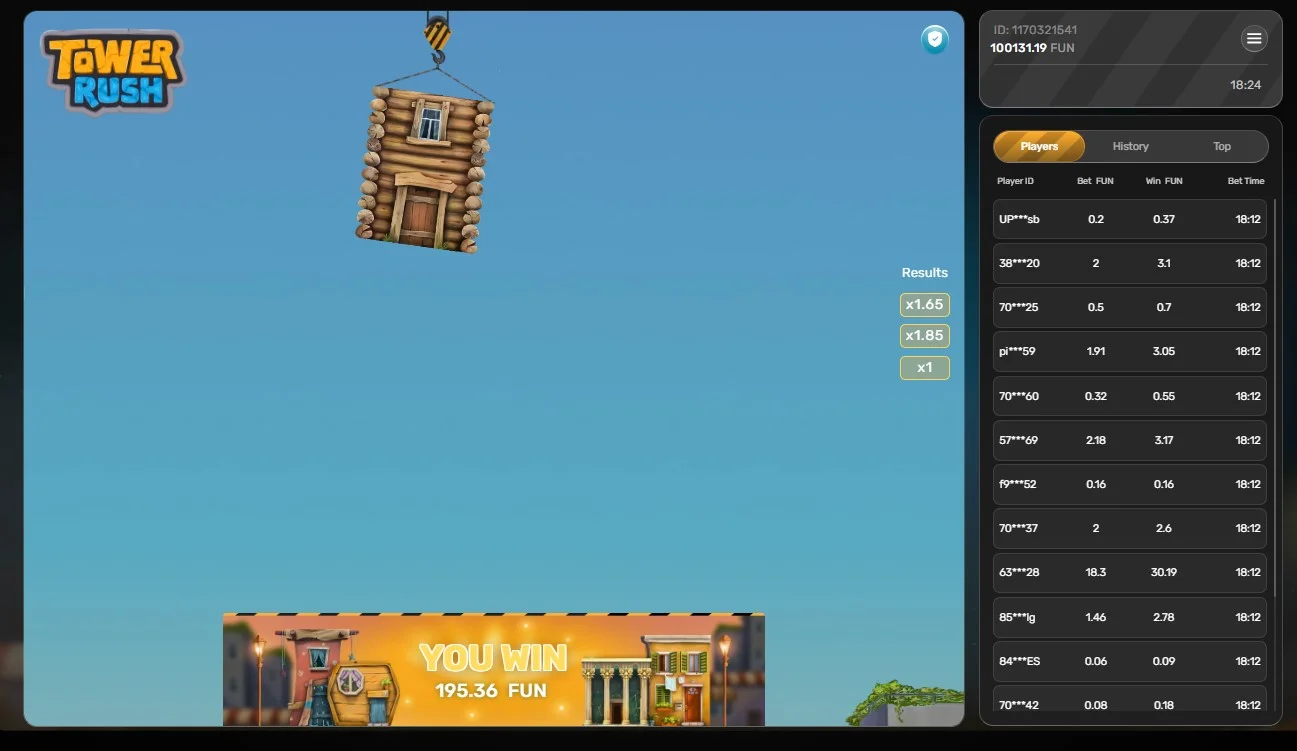
Tower Rush doubles the stakes. You still have the cashout decision — but before that, you must place each block correctly. The crane sways, the block hangs above the tower, and it’s your click that determines whether it lands well or misses the target.
Two types of decisions at each floor:
Technical decision: do I click now or wait for a better alignment? The block sways faster and faster. Waiting gives a better angle but increases the risk of missing the optimal moment.
Strategic decision: do I cash out at this multiplier or attempt an additional floor? The higher the tower goes, the greater the potential gain — but the technical difficulty of placement also increases.
It’s this overlay that creates the tension unique to Tower Rush. You’re not managing a single parameter — you’re managing two simultaneously. And they interact: even if you strategically decide to continue, your technical ability can betray you. Conversely, you may be technically capable of placing a block on the fifteenth floor, but decide that a x12 is sufficient and cash out.
The evolution of difficulty — what your fingers need to know
Progression is not linear. The first three or four floors forgive a lot — the block moves slowly, the landing zone is wide. This is the ramp. Everyone gets through.
Around the fifth or sixth floor, something changes. The swaying widens, the pace quickens, and the placement window narrows. This is where the game really begins. Players who cash out early (x3-x5) never feel this transition. Those aiming for x8 or more know it intimately.
Beyond the tenth floor, the margin for error becomes almost nonexistent. The block sways erratically, and each placement is an act of precision. I’ve seen experienced players miss blocks on the twelfth floor after perfectly succeeding on the previous eleven. A click a fraction of a second too late, and the tower collapses with a x25 multiplier flying away.
The three bonuses — and how they interact with construction
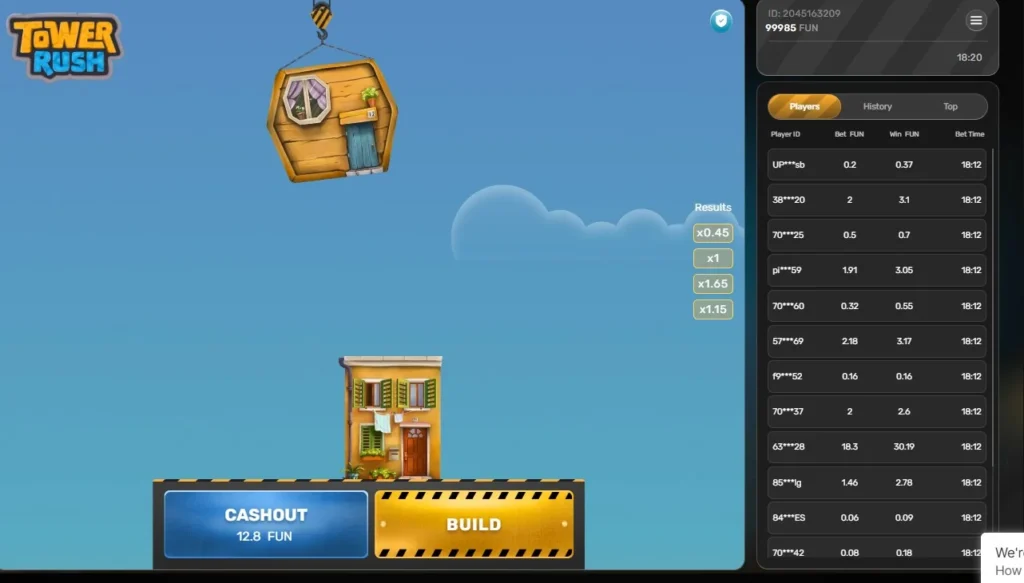
What makes the bonuses of Tower Rush particularly interesting is that they are not just additional multipliers. Each interacts differently with the tower building mechanic.
Frozen Floor — the safety net
When the Frozen Floor appears, your current multiplier is frozen as the minimum payout. The tower can collapse afterwards — you cash out at least the frozen level.
Interaction with the construction: The Frozen Floor radically changes your risk-reward relationship. Without it, each additional floor is a total gamble: you either win more or lose everything. With it, each additional floor is an asymmetric bet — you can win more, but the worst that can happen is hitting the frozen level. It’s the only bonus that alters the player's decision-making structure, not just the outcome.
In practice, when a Frozen Floor appears at x6 or x7, I systematically continue for three or four additional floors. The downside is secured. The upside is open. It’s exactly the moment to take risks — because the risk is no longer really a risk.
Temple Floor — the random boost
A wheel of fortune with segments of varied multipliers. The outcome is entirely random. Sometimes a small boost, sometimes a significant jump.
Interaction with the construction: The Temple Floor does not affect placement — the tower continues normally afterwards. Its impact is purely financial. But it creates an interesting dilemma: cash out immediately with the increased multiplier, or continue building? My instinct says to cash out. The Temple Floor has already improved my position — continuing risks that gift.
Triple Build — the welcome pause
Three blocks placed automatically, with perfect precision. Zero risk of human error for three floors.
Interaction with the construction: It’s the most appreciated bonus by players aiming for high floors. Around floor 8-10, when the technical difficulty seriously increases, a Triple Build offers three floors of respite. The multiplier rises by three levels while your hands rest. And when you take control again, you are at a multiplier level you might not have reached manually without error.
The demo as a training ground
time limit. Virtual credits recharge automatically. The mechanics are identical to the real mode, bonuses included.
But calling it simply «a demo» underestimates what this tool actually allows. In a game where manual skill matters, the demo is not just a preview — it’s a training program.
Three exercises that the demo makes possible:
Timing calibration. Play 20 rounds aiming only for floor 10. Note how many times you reach it. Start again aiming for floor 12. Compare. It gives you a precise idea of your current limits — and shows you where you can improve.
Discipline test. Set a cashout point (for example x7) and play 30 rounds strictly adhering to this rule. No exceptions. Observe your results. Then redo the exercise with x10. The demo concretely shows you the impact of your exit strategy on your balance.
Bonus familiarization. The three bonuses also appear in the demo. Take the opportunity to observe their triggering and think about your reaction before encountering them with real money. The Frozen Floor in particular deserves to be seen in action at least once before playing with money.
Tower Rush vs other crash games — an honest comparison
I'm not going to pretend that Tower Rush is objectively better than everything else. It is different. And this difference suits certain player profiles, not all.
Quick comparison:
Aviator (Spribe) — RTP ~97 %. Passive mechanic. You watch a plane ascend and decide when to cash out. No manual component. More relaxing, less engaging.
Spaceman (Pragmatic) — RTP ~96.5 %. Same principle as Aviator with a different theme. Potentially higher multipliers but similar volatility.
Lucky Jet (1Games) — RTP ~95.5 %. Passive format. Lowest RTP in this selection.
Tower Rush (Galaxsys) — RTP 96.12-97 %. Only game with a manual placement component. Double decision (technical + strategic). More demanding, more engaging.
If you're looking for something relaxed to play in the background, Aviator is probably better suited. If you want to feel that your hands and brain are part of the outcome — and that the tension of each level is part of the fun — Tower Rush is in a league of its own.
The typical journey of a Tower Rush player
After reading testimonials and observing players on forums, a pattern often emerges. Most go through three phases:
Phase 1: discovery (demo). You play without pressure, you understand the rules in two minutes, and you start to feel the difficulty ramping up towards level 6-7. The first cashouts are intuitive — you cash out when fear outweighs greed.
Phase 2: adjustment (first real sessions). The switch to real money changes everything. The same mechanics, but with a different emotional weight. The most common mistakes at this stage: changing plans mid-round, increasing bets after a losing streak, playing too long in a row.
Phase 3: routine (regular player). You've found your target multiplier, your budget per session, your maximum duration. Rounds become a mastered ritual. Losing streaks no longer unsettle you because you understand variance. Bonuses are appreciated when they come but do not change your fundamental strategy.
The demo covers phase 1. Phases 2 and 3 are played for real money — and that's where discipline makes the difference.
Player testimonials on the round mechanics
"What hooked me is that each round is different. Even though the concept is the same, the exact moment you click changes everything. It's like a sport: the rules are simple, but mastery takes time."
"Before Tower Rush, I played Aviator. It's fine, but passive. Here, you feel like you're doing something — not just watching. The Triple Build at the right moment feels like getting a bonus while you're in the middle of the effort. The timing is different from anything I had tried."
"The Frozen Floor on the eighth level, with a x9 in the bank — and then you let loose. I reached x16 in that round. Without the Frozen Floor, I would have cashed out at x9 without hesitation. This bonus completely transforms the psychology of the round."
"The mechanics are great but tiring. After 20 minutes, my concentration drops and I start missing blocks that I was placing correctly at the beginning. It's a game to be consumed in small doses — which is also a good natural safeguard against excessive play."
Official game technical sheet
| Parameter | Value |
|---|---|
| Developer | Galaxsys |
| Game type | Crash game with manual block placement |
| RTP | 96.12 % – 97 % |
| Volatility | High |
| Minimum stake | 0,10 € |
| Maximum stake | 100 € |
| Maximum gain | €10,000 or 100x the bet |
| Integrated bonuses | Frozen Floor, Temple Floor, Triple Build |
| Technology | HTML5 / Provably Fair |
| Mobile | Yes — browser, no download |
Frequently asked questions
Yes, partially. Block placement requires timing and precision, especially at high floors. The cashout decision remains purely strategic. Both skills coexist.
Yes. Same mechanics, same block physics, same bonuses. The only difference: credits are virtual. No features are restricted or modified.
Yes. HTML5, no download. The BUILD and CASHOUT buttons are touch-friendly. Precision is slightly lower than with a mouse at very high floors (above the 12th), but perfectly adequate for cashouts in the x5-x10 range.
Between five seconds (very short round) and one to two minutes (if you reach high floors). Most rounds last between ten and thirty seconds.
No. They are random and infrequent. Each can appear a maximum of once per session. Don't base your strategy on them — consider them as a nice extra.

Jade Dubois
iGaming Writer & Gameplay Analyst
In summary
Tower Rush has found something that other crash games did not seek: a way to make the player physically active in their game. The tower building mechanic is not a gimmick — it is the heart of the game. It creates engagement, tension, and satisfaction at cashout that passive formats cannot reproduce.
The free demo is the ideal entry point. It costs nothing, shows everything the game has to offer, and allows for the development of the necessary timing before moving on to real money. The three bonuses — Frozen Floor leading the way — add layers of decision that refresh the experience round after round.
The game is not for everyone. It requires attention, mentally tires after twenty minutes, and the visual repetitiveness is a real flaw. But for those who want to feel that their input matters — really — Tower Rush is probably the best crash game available in 2026.
Our rating: 4.1 out of 5.
Responsible gaming: Tower Rush is an entertainment product with a mathematical advantage in favor of the casino. Only play with money you can afford to lose. If gaming stops being fun, take a break. For any help: Players Info Service — 09 74 75 13 13.